A simple process ensures your family receives the information they need, when they need it, without compromising your privacy today.
How It Works
You set up your vault once. SafeHerit handles the rest.
Setup
Create Your Vault
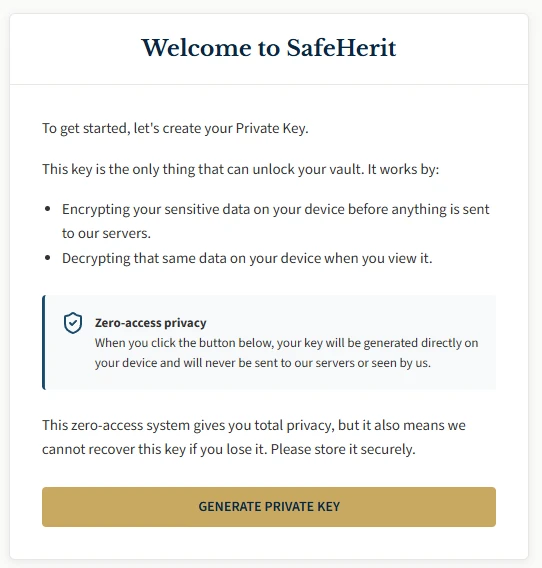
Generate your private encryption key. Only you hold it.
Add Beneficiaries
Define who will receive information and record messages for each.
Add Validators
Choose trusted people who can confirm your status. (Optional)
Set Up Verification
Set how often SafeHerit checks on you.
Ongoing
Record Your Assets
Add or update your asset details at any time.
The Pulse Check
We periodically check in. You seamlessly confirm to keep your vault sealed.
Information Released
When the time comes, each beneficiary receives their assigned information.
1
Create Your Account
Generate and Register Your Key
Start by creating your account with your email address. During setup, SafeHerit generates a unique private encryption key on your device. This key is yours alone. It never leaves your device, and we never see it.
You will download this key as a secure file. Store it somewhere safe, such as a password manager or a secure backup location. You will need it each time you access your vault.
Why This Matters
Your private key is what makes SafeHerit different. Everything you store is encrypted using your key before it reaches our servers. Without your key, your data is unreadable, even to us.
A beneficiary is anyone you want to receive information about your assets: a spouse, a child, a business partner, a trusted friend. You decide who they are and what they will receive.
For each beneficiary, you provide their name and contact information. SafeHerit generates a unique private key for each one, which you download and share with them directly. This key allows them to decrypt only the information you assign to them.
Personal Video Messages
Beyond asset information, you can record a personal video farewell message for each beneficiary. These videos are encrypted and delivered alongside their assigned information when the time comes.
You hold the keys. SafeHerit does not store beneficiary private keys. It is your responsibility to share each key with the appropriate person.
3
Add Validators
Optional
An Additional Layer of Verification
Validators are trusted individuals who can confirm your status if SafeHerit is unable to reach you. They have no access to any information about your assets or beneficiaries. Their sole role is to answer one question: is the account holder still active?
You might choose a close friend, a family member who is not a beneficiary, a colleague, or a professional contact. The choice is yours.
How Validators Are Used
If you do not respond to SafeHerit’s check-ins, the escalation process begins by contacting your validators. This adds a human verification layer before any information is released.
No access to your data
Cannot see assets or beneficiary information
You control who and how many
Add one, several, or none at all
4
Set Up Verification
How SafeHerit Checks On You
SafeHerit uses a system called Pulse Check to periodically verify that you are still active. You choose how often these check-ins occur: monthly, bi-monthly (every 60 days), quarterly, or a custom interval.
When a Pulse Check is triggered, SafeHerit contacts you by email. If you have registered a phone number, SMS is used as an additional channel. You simply confirm that you are active. If you respond, nothing happens. Your vault remains locked, and your information stays private.
What Happens If You Do Not Respond
If you miss a check-in, SafeHerit follows a defined escalation process. This includes additional contact attempts and, if you have added validators, reaching out to them for confirmation. Only after all verification steps are completed does the release process begin.
You can update your Pulse Check frequency at any time.
5
Record Your Assets
Document What Matters
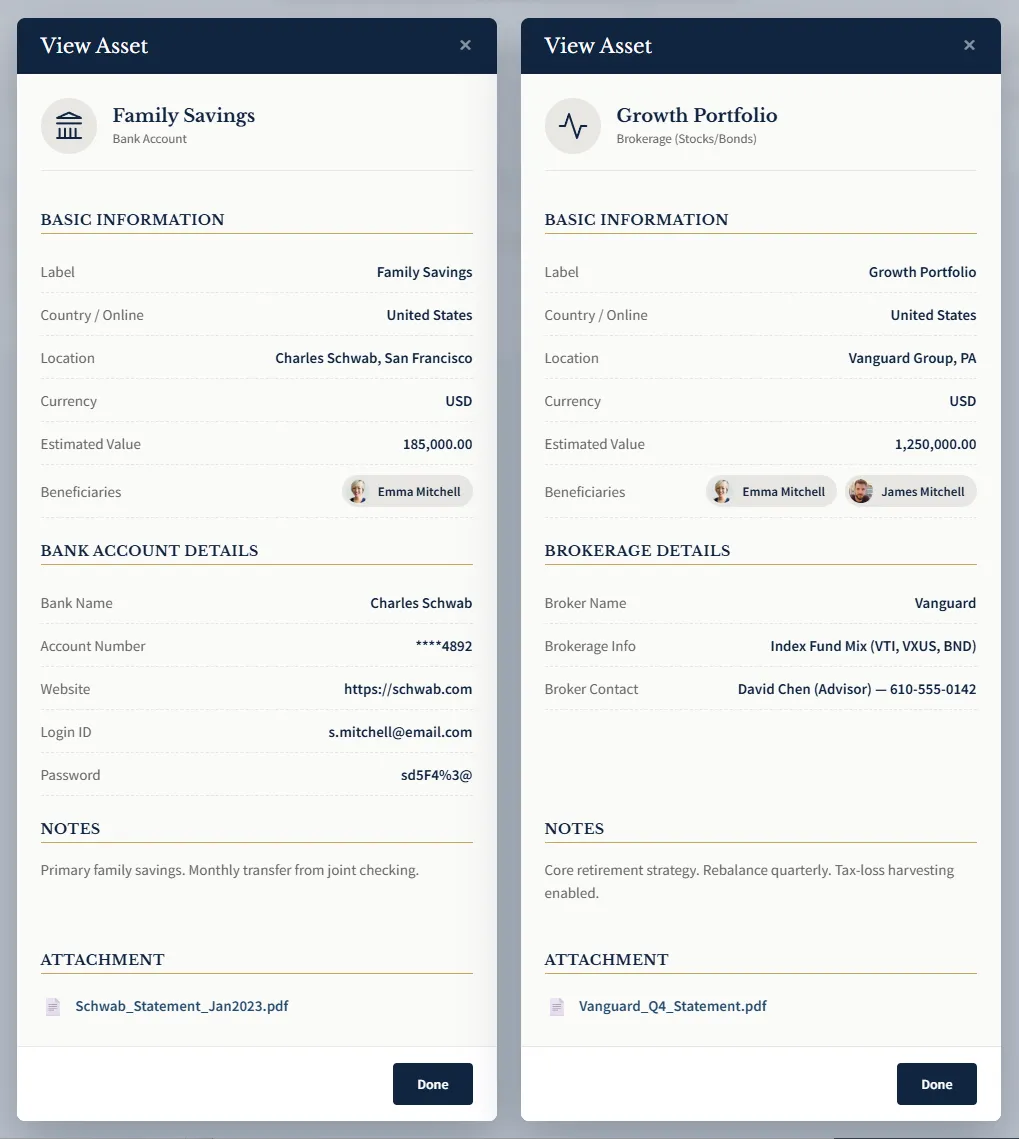
With your beneficiaries in place, you can now record the information each one needs to know. SafeHerit is designed to store information about your assets, not the assets themselves. This includes account details, locations, access instructions, and anything else your beneficiaries would need to locate and manage what you leave behind.
For each asset, you assign one or more beneficiaries. When the time comes, each person receives only the information you have specifically assigned to them.
What You Can Record
SafeHerit supports a wide range of asset types: bank and investment accounts, real estate, insurance policies, business interests, cryptocurrency holdings, digital accounts, physical valuables, and more. You can add as many assets as you need and update them at any time.
Every asset you record is encrypted using your private key before it leaves your device. SafeHerit cannot read your asset information.
Click or tap to enlarge image
6
The Pulse Check
Click or tap to enlarge image
Confirm You Are Active
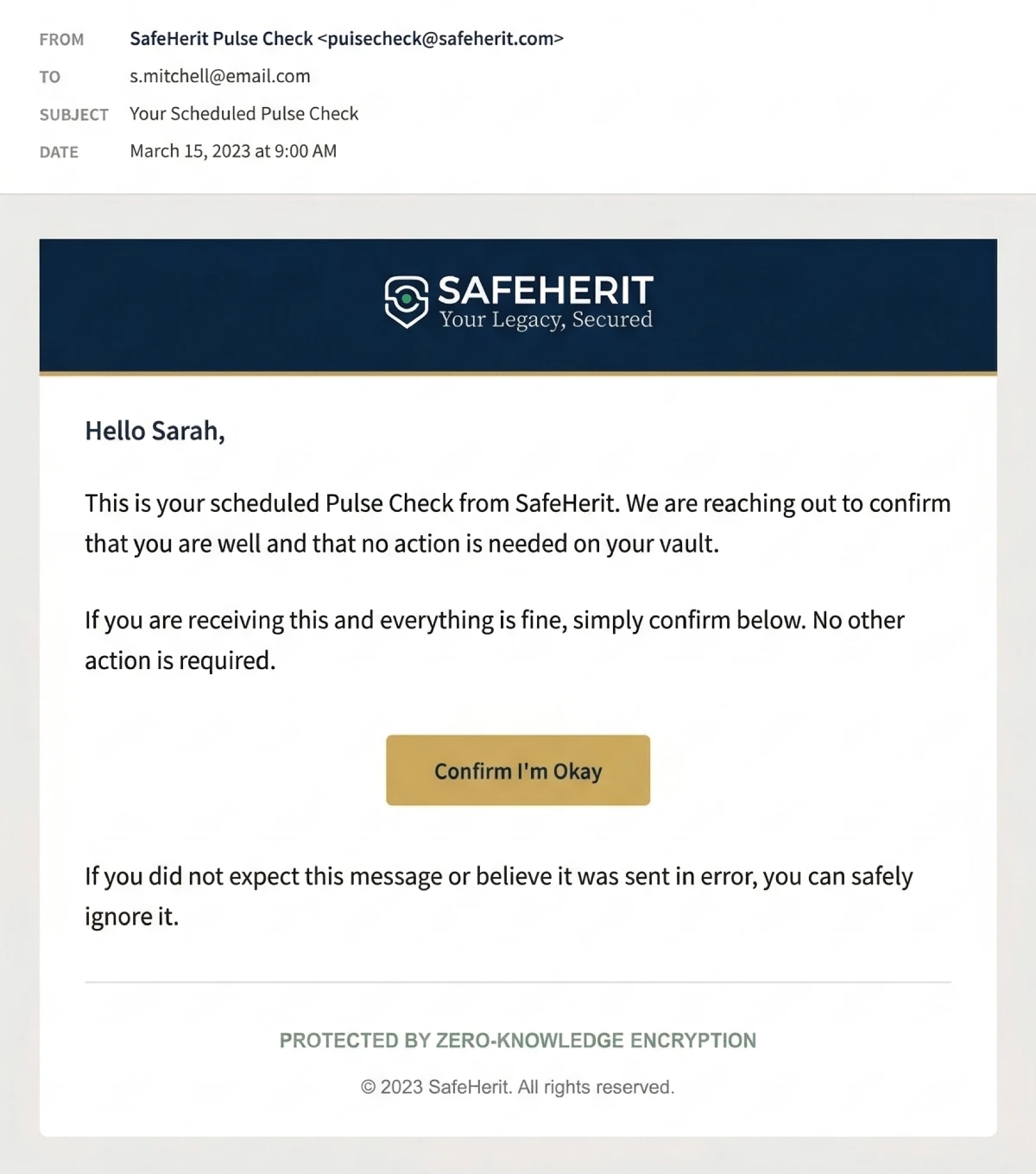
Once your vault is set up, SafeHerit periodically reaches out to confirm you are still active. At the interval you selected, you receive a Pulse Check: a message asking you to confirm your status.
Responding takes seconds. A single click or tap confirms you are active, and SafeHerit resets the timer until your next check-in. Your vault remains locked, and nothing changes.
If You Do Not Respond
Life happens. If you miss a check-in, SafeHerit does not immediately release your information. Instead, it follows the escalation process: additional contact attempts through your registered channels, and if you have added validators, outreach to them for confirmation. Only after all steps are completed does the release process begin.
Low friction
Responding takes just a few seconds
Multiple safeguards
Retries and validator confirmation before release
Adjustable anytime
Change your check-in frequency whenever needed
How The Pulse Check Works Watch how SafeHerit verifies your status before releasing information to beneficiaries.
7
When the Time Comes
A Careful Process
If you do not respond to a Pulse Check and the escalation process confirms you are no longer active, SafeHerit begins the release. Your beneficiaries receive only what you assigned to them, protected until the moment they need it.
1
Beneficiaries are notified
Each beneficiary receives a notification informing them that information has been prepared for them.
2
They use their key
Using the private key you shared with them, each beneficiary decrypts only the assets you assigned to them.
3
Information is revealed
They see the asset details, access instructions, and any personal video message you recorded.
No searching through paperwork. No guessing where to look. No critical information lost forever. The people you care about receive exactly what they need to move forward, because you took the time to prepare it for them.
“We moved from the US to Dubai three years ago and still have accounts back home, plus new ones here and some in the UK. My wife wouldn’t know where to start if something happened to me. It’s not even just about the money, it’s about the information. Where things are, who to contact, what reference numbers to use. That’s what SafeHerit stores.”
Jay P., Management Consultant
“I wasn’t sure how the beneficiary thing would work but it’s pretty straightforward. You add the person, assign them to specific assets, and they get their own key. They can’t see anything until the trigger conditions are met. I assigned my husband to everything personal and my business partner to the business accounts. It was done much faster than I thought.”
Vanessa L., Interior Designer
“The disclosure logic is what sold me. It’s not just ‘if you don’t hear from me release everything.’ There’s a whole verification process. The Pulse Check, then the validators confirm, and only then does the beneficiary get access. You can configure how aggressive or cautious you want it to be. That level of control matters when it’s about your wealth.
George A., Risk Analyst
A close friend of mine passed away suddenly last year. He was 43. His wife spent months trying to piece together their finances. She didn’t even know about one of their bank accounts. That shook me. I looked into SafeHerit, set it up over a weekend, and now my partner has a clear path to everything if the worst happens.
Greg H., Architect
“I work in infosec. I’ve seen how companies handle ‘encrypted’ data. Most of them hold the keys, which means it’s not really your encryption, it’s theirs. SafeHerit doesn’t hold the keys. Your data is encrypted on your device before it’s ever transmitted. That’s a fundamentally different architecture and it’s the right one.”
Stefan W., Information Security Manager
“I’m not very techy and I was worried it would be confusing. It really wasn’t. Every step has a clear explanation. Add an asset, pick the type, fill in the details, choose who gets it. I added twelve assets with details and attachments in about forty minutes.”
Brenda Y., Retired Teacher
“I was expecting it to be a whole weekend project, but the whole setup took me maybe an hour and a half. I liked how it walks you through the asset types. Bank accounts, brokerage, real estate, crypto, insurance… you just pick the type and fill in the details. I didn’t have to figure out how to structure anything. It was already organized for you. “
Derek N., Sales Director
“I kept telling myself I’d put everything in a spreadsheet. Said that for about three years. SafeHerit finally got me to actually do it because it was simple enough that I ran out of excuses. Now it’s all in there, and I love that I can easily update it anytime.”
Rachel T., Operations Manager
“I’d been meaning to organize all this stuff for years. Bank accounts, insurance, the deed to the house, retirement accounts, all of it was either in my head or in a drawer somewhere. SafeHerit made me actually sit down and do it. It took an afternoon to find all the details I wanted to include, but the actual input was very easy.”
H
. Tanaka, Consultant
When my mum had her stroke we spent weeks just trying to figure out which bank her pension was even with. Nobody knew anything. We found some statements in a drawer eventually but it was a nightmare. I signed up for SafeHerit that same month. My kids are not going through that.
Priya N., Pharmacist
“I spent weeks researching before I trusted SafeHerit. Then I actually tested it. Your data really does get encrypted before it leaves your machine. They can’t see it even if they wanted to. That’s not marketing, that’s how the thing is actually built. I wouldn’t have trusted anything less than that.”
Alex K., Security Engineer
“I travel a lot for work. Southeast Asia, Middle East, sometimes for weeks at a time. There’s always this thing in the back of my head like, what if something happens while I’m in the middle of nowhere? My business doesn’t stop just because I’m unreachable. I put everything on SafeHerit so my partner and my COO each know exactly what they’d need. It’s one of those things where you feel lighter once it’s done.”
Sam T., Import/Export
“I run a business but don’t have a co-founder. It’s just me. If I’m out of the picture, my wife would need to either wind down the business or find someone to run it, and either way she’d need access to everything. Client list, hosting, payment processor, the works. I couldn’t find a good way to hand that off until SafeHerit. Now it’s all documented and she’s the beneficiary for the business side.”
Omar E., Small Business Owner
“After our son was born, my husband asked me ‘if something happens to you, where’s everything?’ And I just… didn’t have an answer. I found SafeHerit and sat down one Sunday afternoon and got it all in. Every account, every policy. Took maybe two hours. Should’ve done it years ago honestly.”
Sarah M., Marketing Director
“I was sick for about a week last year and my business partner couldn’t even log into our payment processor. He kept texting me for credentials. And I just thought, what if I couldn’t answer those texts? Put everything into SafeHerit that weekend. Business stuff goes to him, personal stuff goes to my wife. Done.”
Marcus J., Agency Founder
“My brother’s not technical at all. If I died tomorrow he’d be staring at a Ledger he doesn’t know how to turn on, trying to figure out which wallets have what and which seed phrases go where. I used SafeHerit to write out every step he’d need, and he won’t see any of it unless something actually happens to me. That’s what sold me.”
Yuki S., Independent Trader
“Second marriage, two kids from my first, one from his. It gets complicated fast. I needed a way to make sure specific things go to specific people without everyone seeing the full picture. SafeHerit let me do exactly that. My lawyer handles the legal will, this handles the ‘here’s how to actually find and access everything’ part.”
Natalie B., HR Director
“The key architecture is sound. Keys are generated client-side. The private key is encrypted with a derivative of your password and stored locally, never sent to the server. Public keys are stored server-side for encrypting data encryption keys. It’s a proper envelope encryption scheme. I’d have designed it the same way.”
Rohan P., Cloud Security Architect
“Updating a will through our lawyer costs about $500 every time. And we’d need to update it every time we open a new account or change a beneficiary. SafeHerit costs a fraction of that per year and I can update it whenever I want. It doesn’t replace the will, but it handles the part the will was never good at anyway.”
Brian L., Small Business Owner
“I run a consultancy with my partner. If something happened to either of us, the other one would need access to client files, vendor contacts, payment systems. Our personal families would need completely different things. I really liked how Safeherit lets you separate personal from business and assign different people to each.”
Diane K., Managing Partner
“The Pulse Check thing was a bit weird at first, like why is this app asking me if I’m alive? But once you understand the logic it makes total sense. It checks in periodically, and if you don’t respond it escalates to your validators. Only after that whole process does anything get disclosed. It’s actually really well thought out.”
Phil T., Mechanical Engineer
“I’m not a technical person and I don’t understand encryption at a deep level. But I understand that SafeHerit can’t see my data, and that even if they were hacked my information would still be protected. The fact that it’s built into the system and not just a policy someone could change is what matters to me.”
Laura B., Real Estate Agent
“I’ve audited enterprise encryption implementations for years. Most companies do it wrong: keys stored alongside data, server-side decryption, key escrow with the vendor. SafeHerit does it right. Client-side encryption, user-held keys, zero knowledge on the server. It’s textbook correct and honestly that’s rare.”
Owen J., Security Auditor
“I’m on Ethereum, Solana, and a few L2s. Different wallets for different things, different seed phrases, some in metal, some on paper. If my sister had to figure this out on her own it’d be impossible. SafeHerit lets me lay out exactly what’s where and how to recover it, and she can’t see any of it until it’s actually needed.”
Nico M., DeFi Researcher
“My aunt passed away last year and it took the family over a year to figure out her finances. She had accounts nobody knew about. Money that just sat there. I swore I wouldn’t put my kids through that. SafeHerit gives me a way to make sure they’ll know about everything without me having to hand over the details while I’m still alive.”
Michelle R., Project Manager
“In our business we use something like twenty different tools at this point. Stripe, AWS, Cloudflare, our CRM… Every password was either in my head or buried in a Slack message from two years ago. I knew it was a problem, just didn’t know what to do about it. SafeHerit gave me a place to actually organize all of it and decide who gets what if something happens to me.”
Kevin O., CTO, E-Commerce
“I’m a privacy-first person. I don’t use cloud storage for anything sensitive. I don’t trust companies with my data as a rule. SafeHerit is the one exception because they’ve built it so they literally can’t read my data. If a court ordered them to hand it over, all they could provide is useless encrypted data. That’s the standard I need.”
Mikhail S., Privacy Consultant
“I used to keep sensitive documents in a cloud drive. Then I realized that Google, Microsoft, whoever… they all hold the keys to decrypt my files. They can read them if they want to. SafeHerit can’t. It’s a completely different model and once you understand the difference, you can’t ignore it.”
Jason F., Systems Administrator
“The thing that convinced me is the breach scenario. Even if SafeHerit’s servers get compromised, all an attacker would get is encrypted data they can’t decrypt. The keys aren’t there. That’s the whole point of zero-knowledge architecture and it’s why I’m comfortable storing sensitive information here.”
Hassan M., Network Engineer
Protect What Matters Most
Setup takes under 10 minutes. Your family’s peace of mind lasts a lifetime.